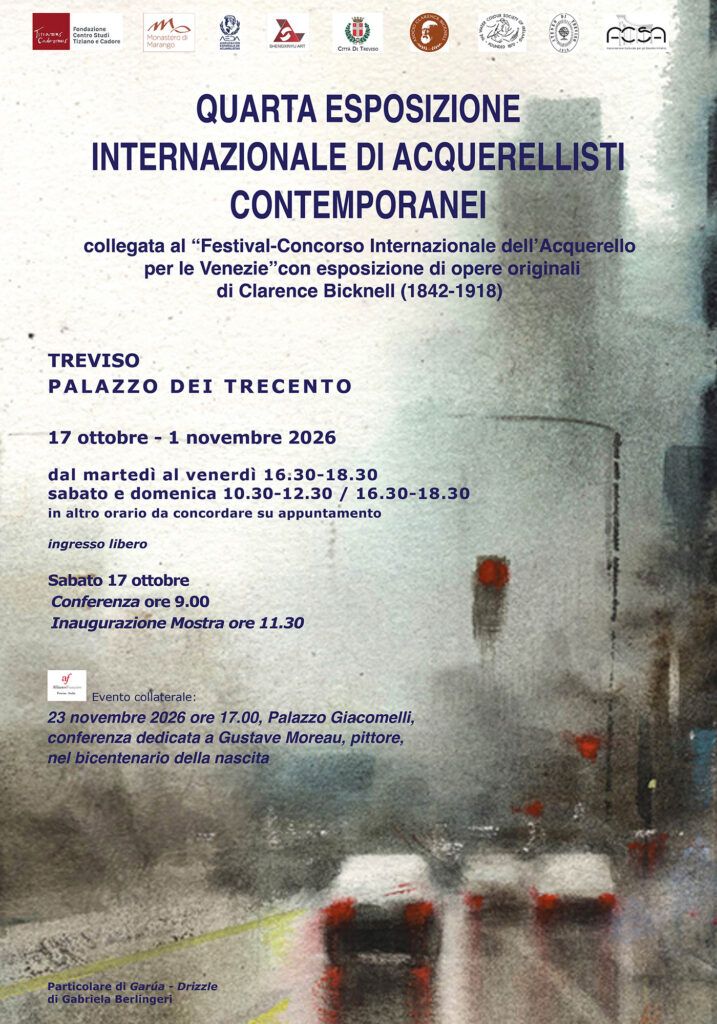
 The exhibition of art by Clare Bicknell in Treviso near Venice, Italy, is the biggest ever, whether in his lifetime or more recently. It is more extensive even than the exhibition of Clarence’s work for the celebration of the Bordighera culture award The Parmurelu d’Oru in 2017. And Treviso, for the first time, by demand of the organisers, original watercolour landscapes by Clarence were framed and exhibited.
Download this 10-page report in pdf complete, for printing off
The featured artist in the 2026 Le Venezie Watercolor Festival, an annual event organised by the Associazione Culturale per gli Scambi Artistici (Italian Cultural and Art Exchange Association) and Sheng Xinyu Art of China, founded in 2002, a cross-cultural international art exchange and art promotion platform promoting the communication, connection and cooperation between Chinese artists, art institutions around the world including the USA. It runs international art exhibitions and publishes articles on global art information, art competitions, exhibitions and events with an average of more than 1.5 million viewers every year including exhibition visitors , on their social media and on their website https://shengxinyuart.com and on China’s public website https://art.china.cn. The city of Treviso sponsored the event and provided the location, an extraordinary 13th century wood-timbered hall in the Palazzo dei Trecento which dominates the town hall and the main square. The Clarence Bicknell exhibits were given pride of place at the entry to the exhibition and comprised 50 pictures on three grid-wall display panels and two glass-covered display cases kindly lent by the city library.
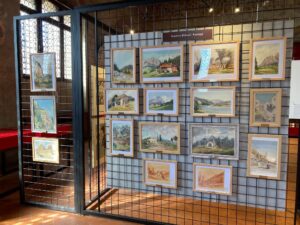 There were 15 original landscape watercolours by Clarence Bicknell never before seen in public (including of Cortina d’Ampezzo in the mountains in the Dolomites – so of local interest to people in Treviso, and of trip to Egypt in 1889)(photo, left, upper); 17 prints of water-colours of Alpine flowers from the celebrated Casa Fontanalba Visitors’ Book, wildflowers in strong colours, botanically perfect and surrounded by borders and details in an Arts-and-Crafts style (photo, right); and a dozen symmetrical images and pages of Victorian whimsy from the albums in the Fitzwilliam Museum, University of Cambridge, like The Triumph of the Dandelion and poems illustrated with floral borders. (photo, left).
In the glass display cabinets (image, right) we showed originals of some of Clarence‘s books and artefacts from his life like a box of watercolour pants, his silver insignia of the Societas Sancti Spiritus (The Brotherhood of the Holy Spirit) from his days as an Anglican cleric at Stoke-upon Tern (image, right) (https://clarencebicknell.com/photo-of-clarence-in-1883-in finalmarina/ ), several of his pocket sketchbooks showing miniature watercolour and pencil sketches which he did everywhere he went (image, right, diary of his trip to Egypt 1889) and other items from Bicknell’s life. Four large A1 size colour-printed panels in three languages gave the background to Bicknell‘s life and work. The list of Clarence Bicknell items, in Italian, can be seen here.
Our friend, art expert Zhang Hongbin, is one of the organisers. He writes “The 2026 is organized around the theme Heritage and Expedition: The Memory and Contemporaneity of Watercolor. This is conceived as an act of commemoration — honoring Elhanan Bicknell (1788–1861), one of the most consequential British art patrons and collectors of the nineteenth century, and his descendant Clarence Bicknell (1842–1918). By retracing the contributions of this family across two generations, the Festival seeks to illuminate a fundamental truth: that the inheritance and flourishing of watercolor art have never rested on the talent of individual artists alone, but are deeply embedded in a broader cultural ecology — one sustained by patronage, collecting, scientific inquiry, and humanistic vision working in concert.” Elhanan Bicknell owned 31 pictures by Turner who was the featured artist at the 2025 festival here. The Clarence Bicknell was the featured artist in The Festival-Concorso Internazionale dell’Acquerello per le Venezie, to give it its title in Italian, the major art competition of which the Clarence Bicknell exhibits were a featured part.
The finalists, a wealth of watercolours entered by artists from all over the world, were displayed for the two weeks and the prizes awarded. You can see a list of winners at https://venicewatercolor.com/award_category and below. I was honoured to be one the judges of the various categories of the competition overall. Susie and I also selected works to be honoured with the Clarence Bicknell Award, watercolours of botanical art or scenes with connections to my Victorian great grand uncle. Most of the entries in the botanical artist class were of cultivated flowers, not a genre which interested Clarence much so we chose a butterfly in a flower as the winner. All the winners received a copy of the Casa Fontanalba Visitors’ Book with a dedication in the front page. Here are the four winners of the Clarence Bicknell Award.
1st: Podalirio at noon – Elisa Vitullo (Italy). I noted “The subject matter is superb and the artist has given herself a head start by selecting it. But her vision of the pose, the legerity of the butterfly on the flower stem and the contrast of the dense colouring of the Lepidoptera with the pale flower and background is superb. Look at the way the twin tail dominates and emphasises the diagonal of the structure of this image; very well-conceived. Eloisa writes on her Instagram “The Podalirio — also known as the zebra butterfly — is a fascinating
insect, admired not only for its beauty but also for its survival strategies and its connection to mythology. Podalirius was a god of
medicine and a skilled healer in his own right. This aspect evokes the capacity to heal not just the body but the soul, carrying with it esoteric meanings associated with transformation, healing, and rebirth. His brother was Machaon, who was also a physician. In his Systema Naturae, Linnaeus gave their names to two butterflies: Podalirius and Machaon. Thank you for the insights and for the watercolour.”
2nd: Songzhuang ancient bridge – Liu Lingfeng (China). “I love the atmosphere round this bridge which is reminiscent of the similar
bridge at Dolceacqua above Bordighera which Clarence loved and painted several times”.
3rd: The secluded violets spread in order – Xu Lin (China). “I found the technique you used was excellent and realistic but with the soft touch of watercolour. The result is a tranquil scene which draws the onlooker in. Each violet seems to be alive and this is a great quality. This image has great relevance to my great grand uncle Clarence Bicknell because he drew and painted wild violets quite frequently.”
Highly Commended: River Crossing – Rayhan Mia (Bangladesh). The artists was not able to submit his original art in time nor could he get a visa to come to Treviso. My notes were on an electronic copy of the picture. “What a splendid use of watercolour to enlighten a microcosm of the world of these villagers crossing a wide river. Is it the Nile or is it the Meghna River, the Jamuna River or the Padma River in Bangladesh? Technique and brushstrokes are simple but this adds to the relaxed feeling to the scene. The figures are drawn in a naive style which is also entirely suitable to the subject matter. The fishing felucca to the left and other boat complete a remarkable scene. There are watercolours in Clarence Bicknell’s diary of his trip to Egypt in 1889 which take in the same subject matter, so I find this picture even more appealing. Congratulations on a great piece of art.”
Conference on Botanical Art
Marcus participated in the conference which started the opening day of the exhibition, presenting a paper on Clarence’s botanical art. The conference was on Botanical Art, with Raffaello Padovan, art historian, associate of the Ateno di Treviso and Dino Carpenè, botanist – organised by Giandomenico Padovan of the
Italian Cultural and Art Exchange Association and principal mover of the festival, the competition and the conference.
You can find out about Giandomenico Padovan and the Associazione Culturale per gli Scambi Artistici (Italian Cultural and Art Exchange Association) at https://www.facebook.com/100091862228573. The Le Venezie International Watercolor Festival is operated and driven by a highly professional and genuinely
international organizing team. At its core are Zhang Hongbin and Ji Yinglun, founders of Shengxinyu Art (China), Raffaello Padovan, President of the Italian Association for Cultural and Artistic Exchange, his son Giandomecnico Padovan and Sandra Miranda Pattin, a distinguished Italian curator. Together with
representatives from art associations in China, the United Kingdom, and Italy, the team embodies the artistic strengths of Asia, continental Europe, and Britain, forming a robust collaborative framework that transcends cultural and geographical boundaries.
We started the conference with a projection of the 18-minute long film Le Meraviglie di Clarence Bicknell, in Italian, made by Rémy Masséglia in 2017. You can view it at https://vimeo.com/clarencebicknell/meraviglie and on YouTube.
My thanks to Valentina Pulinetti of San Remo, photographer (https://clarencebicknell.com/in-clarences-footsteps-valentina-pulinetti/), for perfecting the text in and coaching me in pronunciation an delivery. You can see my
Italian text and samples of the slides here. English translation follows below the Italian.
Buongiorno a tutti. È un vero piacere essere qui a Treviso per l’inaugurazione del “Le Venezie Watercolor Festival 2026”, che vede protagoniste le splendide opere di mio zio Clarence Bicknell. Susie ed io abbiamo lavorato intensamente a questa mostra, selezionando e incorniciando sia gli acquerelli paesaggistici originali di Clarence (mai esposti al pubblico fino ad oggi) sia le stampe tratte dalle sue straordinarie illustrazioni botaniche, custodite in album rilegati in pergamena. È opportuno spiegare perché Clarence Bicknell sia l’artista protagonista del festival di quest’anno. L’anno scorso, il protagonista era Turner. Elhanan Bicknell fu il primo e più celebre collezionista di opere di Turner (ne possedeva trentuno). Suo figlio era Clarence Bicknell – botanico, archeologo, artista e studioso poliedrico – al quale è dedicata l’edizione di quest’anno. Padre e figlio incarnano la profonda evoluzione del gusto artistico nel corso del diciannovesimo secolo: dal realismo classico di Constable e Reynolds si sviluppò quel movimento di cui Turner fu il massimo esponente, caratterizzato da colori, luce e atmosfera.
Clarence Bicknell era cresciuto disegnando fiori al parco insieme alla madre Lucinda, anche lei artista; lei considerava questa attività un modo per aprirgli gli occhi sul mondo naturale, osservando e ritraendo i fiori. Clarence studiò la tassonomia. Durante i quindici anni trascorsi come pastore anglicano in Inghilterra, disegnò fiori con regolarità, come forma di disciplina. Quando si trasferì a Bordighera, sulla costa mediterranea, nel 1878 all’età di trentasei anni, il mare, il sole, le montagne e la flora suscitarono in lui un entusiasmo travolgente; iniziò così a dipingere per pura gioia. Abbandonò la carriera ecclesiastica e divenne un
esperto botanico e artista. Pubblicò un volume di acquerelli raffiguranti i fiori della Riviera, realizzati con grande rigore scientifico. La sua arte evolse in una direzione simile a quella di William Morris, Voisey e de Morgan – figure di spicco del movimento britannico *Arts and Crafts* – con un profondo impegno verso l’artigianalità, i motivi organici e la progettazione integrale degli spazi domestici.
I disegni floreali di Bicknell si trasformarono in arte decorativa, caratterizzata da bordure ed elementi ispirati ai colori e alle forme dei fiori stessi, come dimostra il Libro degli Ospiti di Casa Fontanalba, di cui qui sono esposte quindici tavole. La sua osservazione era attenta e minuziosa: se inseriva un baccello in una cornice floreale in stile *Arts and Crafts*, lo faceva perché aveva studiato quella specifica parte del fiore e ne aveva colto l’essenza. Il suo universo botanico suggerisce che, più approfondiva la comprensione della bellezza e della rarità delle forme e delle funzioni di una singola parte del fiore, più riusciva a comprendere la bellezza della natura nel suo insieme. Più avanti nella vita, Clarence apprezzava i motivi floreali simmetrici, le storie illustrate con fiori decorativi, le vignette umoristiche e le bizzarrie di gusto vittoriano. Per tutta la vita, Clarence utilizzò vedute ad acquerello per annotare luoghi e date, proprio come oggi faremmo con uno smartphone. I numerosi taccuini tascabili in nostro possesso sono ricchi di paesaggi a matita o acquerello, oltre a schizzi di dettagli che avevano catturato la sua attenzione. Realizzava acquerelli ovunque si recasse: sulle Alpi, lungo il Nilo, a Ceylon o sulla costa nord-occidentale italiana. I suoi paesaggi di dimensioni maggiori sono semplici ed eseguiti con maestria, privi di qualsiasi pretesa; ne esponiamo qui una dozzina, mai mostrati prima al pubblico.
L’arte di Bicknell sta suscitando crescente interesse, poiché è raro trovare figure capaci di spaziare dall’illustrazione scientifica,
praticata in gioventù, all’arte visiva della maturità. Instancabile lavoratore, creò oltre 40.000 opere tra acquerelli, copie di arte rupestre ed esemplari di fiori essiccati, oggi conservati presso università e collezioni in dieci paesi europei: una media di trenta opere al giorno per quarant’anni. Di queste, 4.801 sono disegni botanici, mentre circa 1.500 rientrano nell’ambito dell’arte visiva, riflettendo i suoi stili evoluti ispirati all’Arts and Crafts, nonché motivi decorativi e umoristici. I motivi floreali simmetrici conservati al Fitzwilliam Museum di Cambridge traggono probabilmente ispirazione dal caleidoscopio, un giocattolo molto popolare nell’epoca vittoriana. Così, nell’arco di una sola generazione della famiglia Bicknell – dal rigore di Constable ai motivi floreali in stile *Arts and Crafts* di Clarence – possiamo osservare l’intera evoluzione dell’arte in quel secolo.
Confucio affermava: “Studia il passato se vuoi prevedere il futuro”. In effetti, per garantire il nostro futuro, dobbiamo comprendere il passato. Qual è stato il percorso dell’umanità? Verso quale direzione stiamo andando? Alla luce di ciò, credo che ognuno di noi abbia il dovere di preservare il proprio patrimonio culturale. Clarence Bicknell era consapevole dell’efficacia dell’acquerello mentre lo utilizzava? No, non credo. Lo impiegava semplicemente come mezzo per ritrarre i fiori. Col passare del tempo, si rese conto di quanto piacere quell’attività regalasse a lui e a chi lo circondava.
Trovo gratificante che l’acquerello, come mezzo espressivo capace di catturare sfumature e rappresentare la realtà, continui a prosperare ancora oggi. Nelle opere delle passate edizioni del Venezie Watercolor Festival 2026, così come in quelle esposte in questa sala, riscontro una straordinaria capacità di osservazione e una grande cura nella resa dei dettagli.
English translation
Good morning ladies and gentlemen. What a pleasure to be here in Treviso for the opening of Le Venezie Watercolor Festival 2026 in which the works of my uncle Clarence Bicknell are so beautifully featured. Susie and I have worked hard for this exhibition, selecting and framing both original watercolour landscapes by Clarence (never seen in public till today) and prints of the fabulous botanical art of his vellum-bound albums. These pictures come from the Bicknell family collection, some from the Museo Bicknell in Bordighera and some from the Fitzwilliam Museum of Cambridge University.
It was enlightening in preparing this exhibition to work with Zhang Hongbin of Sheng Xinyu Art, such an interesting co-promoter of Le Venezie Watercolor Festival alongside Giandomenico Padovan and the Associazone Culturale per gli Scambi Artistici. Mr Zhang’s independent and intelligent overview of the role of watercolour in botany, art history, and contemporary ecological consciousness, a tradition with ongoing relevance today assured me of the value of Clarence Bicknell’s watercolours. For Bicknell used watercolour as a means of recording dates and places as we might today with a camera; as a means of recording flowers with both botanical accuracy and the joy of colour and form; as a fund-raisers for charity (some of the landscapes have prices pencilled on the back); as a gift to the people round him. He certainly never thought that his work would in 125 years be in famous museums and in major exhibitions like today’s.
I should explain why Clarence Bicknell and his watercolours came to be the invited as the featured artist in this year‘s festival. Last year you might remember, Turner was the featured artist thanks to the influence of the director of the independent Turner society, Selby Whittingham. When discussing possible artists for 2026, Mr Whittingham mentioned the celebrated Turner collector Elhanan Bicknell and his son, his 13th child, botanist, archaeologist, artist and polymath Clarence Bicknell. The father and son epitomises the massive change in taste in art over the period of the 19th century. From the classic posed realism of Constable and Reynolds grew the movement of which Turner was the chief exponent; colours, light, atmosphere.
Clarence‘s life, and then his art, went in a totally different direction. He had grown up drawing flowers in the park with his artistic mother Lucinda. She saw it as a means of opening his eyes to the natural world, observing flowers and drawing them. Clarence studied Linnaean taxonomy and for the 15 years as a vicar in England he drew flowers regularly as a discipline. When he moved to Bordighera on the Mediterranean coast in 1878, aged 36, the sea, the sun, the mountains and the flora exploded into his spirit; he started painting for joy. He gave up the church and became an expert botanist and botanical painter. He published a book of botanically-accurate water colours of flowers of the Riviera. His art developed in a similar direction to William Morris, Voisey and de Morgan, the most influential figures of the British Arts and Crafts movement, sharing a deep commitment to craftsmanship, organic motifs, and the total design of domestic spaces.
Bicknell’s pictures of flowers developed into decorative art with borders and features taken from the colour and shapes of the flower as in the Casa Fontanalba Visitors’ Book of which 15 plates are displayed here. He observed intently; if he used a seed-pod in an arts-and-crafts style border round a flower, it was because he had seen this part of the flower and realized the. We get the impression from his evolved botanical world that the more detailed he understood the beauty and rarity of the shape and function of a single part of a flower, the more he understood the beauty of nature overall. Later in his life Clarence enjoyed symmetrical patterns of flowers, stories illustrated with decorative flowers, pictorial jokes and Victorian whimsy.
Throughout all of his life, Clarence used watercolour views as a means of recording places and dates, much as we would with a smart phone today. The many sketchbooks, pocket size, which we have in our possession are filled with pencil or watercolour landscapes and other sketches of details and aspects which caught his eye. He made watercolours where ever he went, in the Alps, up the Nile, in Ceylon, on the northwest Italian coast. His full-size landscapes are simple and well executed without any pretension and we display a dozen of them here today, never before seen in public. Bicknell’s art is gaining attention because he is rare among those who delivered both, scientific illustration early in his life and visual art later. The man was a workaholic and created over 40,000 watercolours, rock art copies and pressed flower samples which are in universities and collections in 10 countries of Europe, that’s an average of 30 a days for 40 years. 4,801 of these are botanical drawings of which about 1,500 are visual art, i.e. his evolved arts-and-crafts, decorative and humourful styles. As an artist he was versatile. The symmetrical flower patterns in the Fitzwilliam Museum in Cambridge must have been inspired by the kaleidoscope, such a popular toy in the Victorian era.
So in one generation of the Bicknell family, from the rigour of Constable to the arts and crafts flowers of Clarence we can see the whole of the evolution of art in those hundred years. Specialist researchers in universities like Nottingham, Oxford, Cambridge, Nice, Genoa and Turin show that Bicknell’s instincts about the strength and beauty of the natural world, of the danger presented by the human race and therefore the need for environmental protection were as sound in his time as they are now. He was ahead of his time in many respects. He was a pacifist who devoted himself to works of war charity in times of war; an enthusiastic supporter of women’s suffrage who deplored the excesses of the suffragettes; a vegetarian who never embarrassed others with his prejudices; a man of means who lived in simplicity and devoted his means to others; a master who treated his servants as friends, and embarrassed hosts and hotels by expecting his companion Luigi Pollini to be treated and accepted as a guest and not a servant. In his archaeology and his botany, Bicknell put emphasis on a thorough field search, on a meticulous field record and inventory, on classification, and on considered inference from studious observation in the field and comparative analysis of the record. In short, Bicknell’s efforts make his work the model for work more than a century later.
Confucius is quoted as saying “Study the past, if you would divine the future”. Indeed, to assure our future, we need to understand the past. Where has the human race been? Where are we going? With this in mind, I believe that we each have an obligation to preserve our cultural heritage. What does this mean? Looking after our tangible heritage – that’s artefacts, bricks and mortar – is relatively easy when we have the money; a huge percentage of our cathedrals, churches, museums, palazzi, châteaux, country houses and archaeological digs are funded and preserved, even if it is as much by individual initiative as by the
public purse. The parts of culture which we cannot see and handle are intangible cultural heritage. What is it? It is the intellectual wealth which you and I have inherited from those who went before. Looking after it requires a firm hand but a soft touch. The best guardians of the past are individuals who for profession or for hobby play their part in preserving memories and the positive influence they have on our present but is good to see that bodies like the European Union provide financial support for initiatives designed to protect cultural heritage. When today’s humans are made aware of their heritage then they are more
likely to continue to protect it themselves. Did Clarence Bicknell know how effective watercolour was when he was doing it? No, I think not. He just used it as a
medium for recording flowers. And he realised with the passage of time how much pleasure it gave him and to the people round him.
I find it gratifying that watercolour as medium of nuance and representation is still flourishing today. I see excellent observation and detailed depiction in many of the works in previous editions of the Venice Watercolour festival and those we see around us in this hall.
Report from Treviso by Marcus Bicknell, completed 24 October 2026